Three kinds of machine wearing similar names
Ninja's espresso range looks like one ladder and is actually three separate products that happen to share a font. Sorting them is most of the decision.
The Espresso & Coffee Barista System (CFN601, $279.99) is the odd one out and the cheapest. It takes espresso capsules or ground coffee for drip, has no grinder, and runs a 19 bar pump. It is a drip machine with a capsule habit, not a machine you make espresso on, and we would not cross-shop it against anything else here.
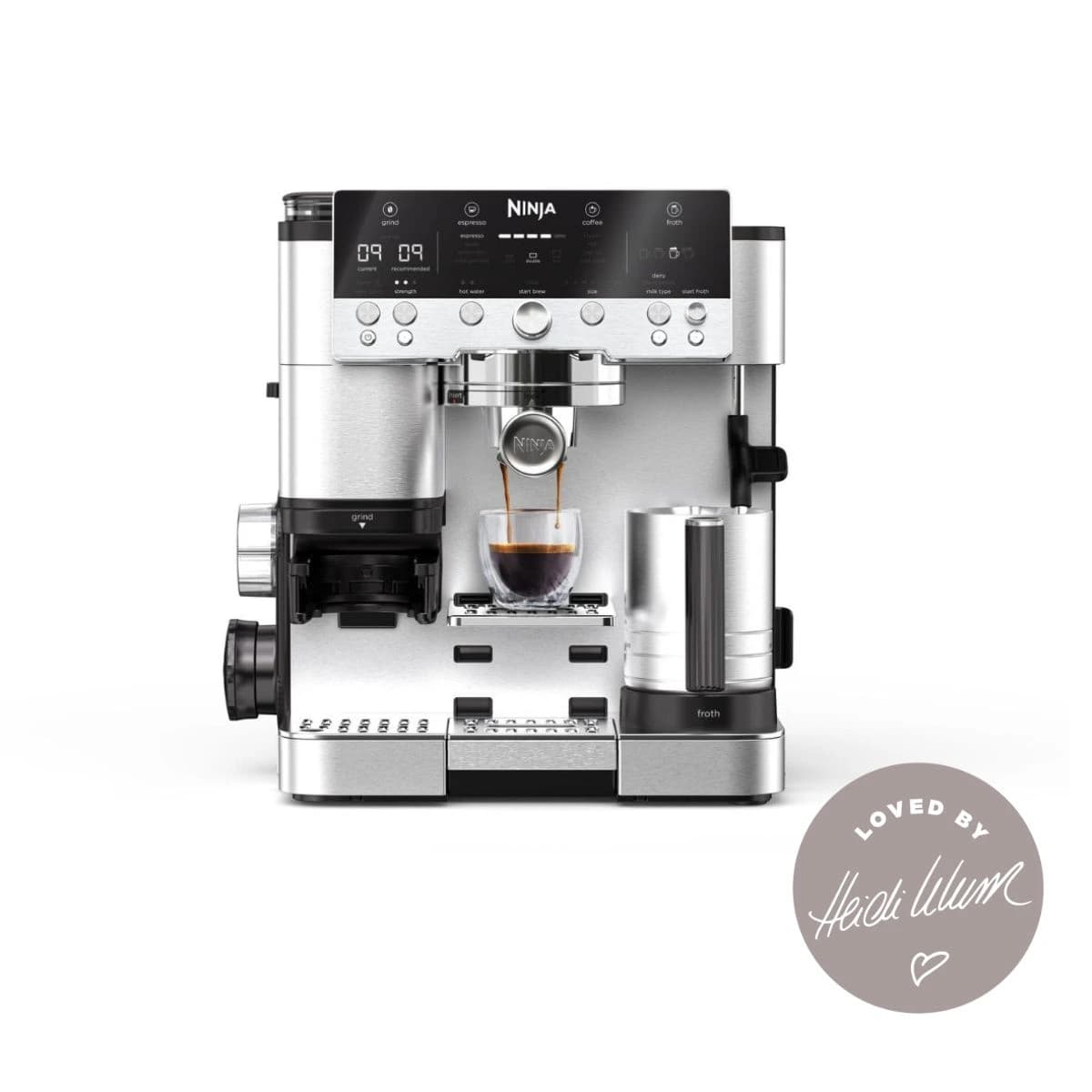
The Luxe Café line is where Ninja actually competes: semi-automatic machines with an integrated conical burr grinder, a built-in scale that doses by weight, and Barista Assist, which recommends a grind setting and adjusts as it brews. Four models, $449.99 to $749.99. You still pull the shot.
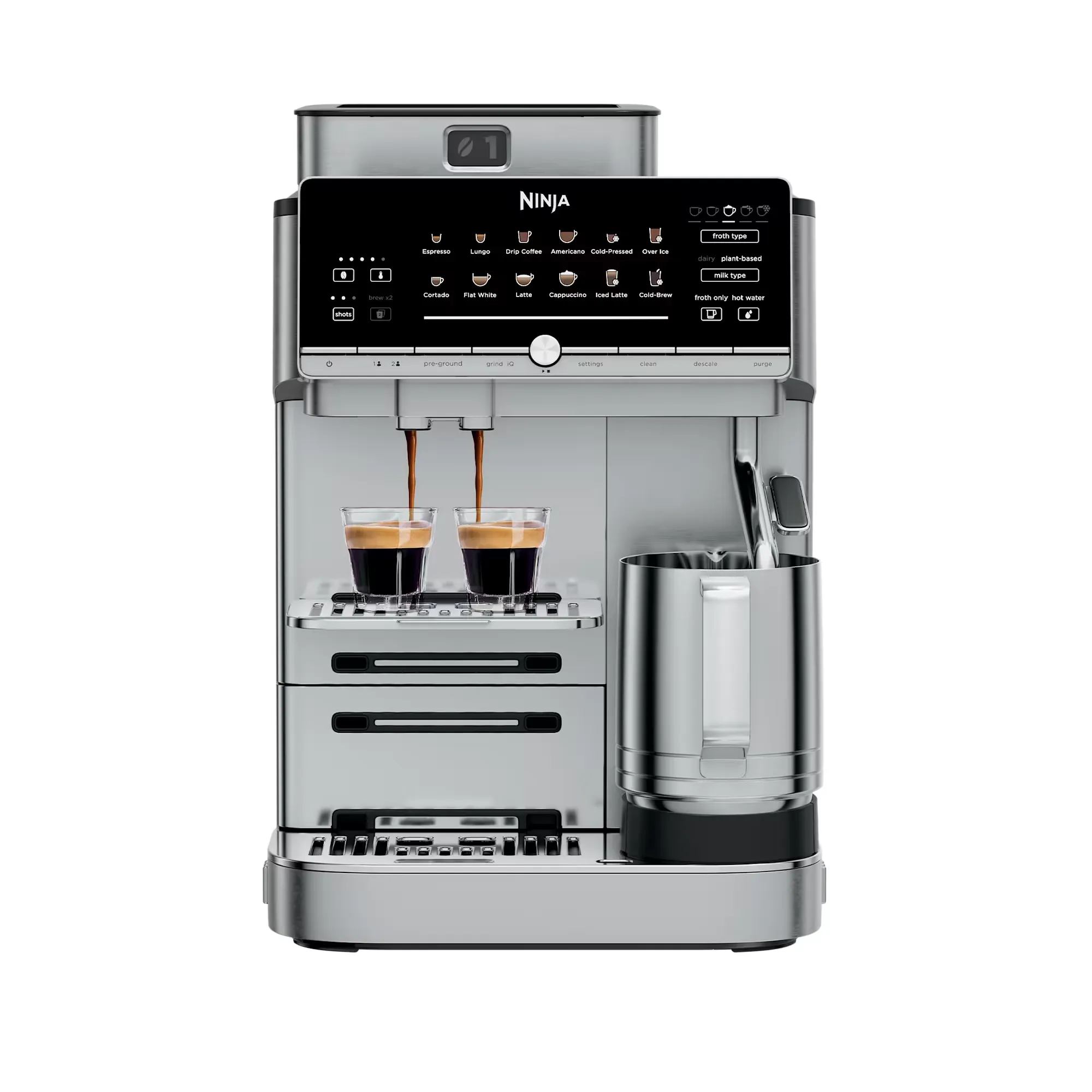
The AutoBarista line (AE1001 and AE1051, $899.99 and $949.99) is a sealed bean-to-cup superautomatic. It grinds, doses, tamps, brews and froths at one touch, and you never see the coffee. Different product, different buyer.
One thing to clear up because the search results confuse it constantly: the Ninja DualBrew is not an espresso machine. It is a drip and pod coffee maker. If you landed here after searching for it, nothing on this page is what you were looking at.
The 9 bar figure, and why it is the most honest number on the box
Espresso machines under $600 almost always advertise a pump rating: 15 bar, 19 bar, sometimes 20. That number describes what the pump can produce against a closed valve, not what reaches your coffee. Real espresso is extracted at around 9 bar, and a machine screaming 20 bar at a pressurised basket is telling you about a component, not a result. We have said this before on the cheap end of the market and it is worth repeating.
Ninja publishes the number the other way round. The AutoBarista Pro's own specification reads as a 15 bar system tuned to 9 bar pressure, and the Luxe Café machines brew at 9 bar into non-pressurised baskets. That is the figure that matters, printed plainly, on machines that cost a few hundred dollars.
It is a small thing and it tells you something real about how the range was designed. Non-pressurised baskets at 9 bar means the coffee has to be ground and dosed properly or the shot fails, which is exactly why Ninja pairs them with a scale and grind guidance. The machine is not faking crema with a valve. That is the reason a $600 Ninja can hold its own against all-in-ones costing more, and it is the single most useful thing to know about the brand.
Every rung of the ladder buys exactly one thing
Once you are inside a line, the price steps are unusually legible. Each one adds a single feature, and if you do not want that feature you should not pay for it.
Mini (ES301, $449.99) to Mini Plus AutoFroth (ES351, $499.99): $50 buys hands-free frothing with three presets instead of a manual steam wand. Everything else is identical, down to the 47 oz tank, the 250 g hopper and the 19 lb body. This is the one upgrade we think most beginners should take, because milk is the step people give up on.
Mini Plus to Premier (ES601, $599.99): $100 buys cold brew, a larger body and Ninja's fuller Dual Froth system with four presets. If you never drink cold coffee, the Mini Plus does the hot half in a machine that is 4 inches shorter.
Premier to Pro (ES701, $749.99): $150 buys a separate hot water system, turning the 3-in-1 into a 4-in-1, plus an integrated tamper instead of tamping by hand and a fifth froth preset. Americanos, tea and pour over become one-touch. If nobody in the house drinks those, this is the weakest step on the ladder.
AutoBarista (AE1001, $899.99) to AutoBarista Pro (AE1051, $949.99): $50 buys two swappable 340 g hoppers instead of one fixed 250 g hopper, three more drink presets, and two saved user profiles. If your household runs decaf alongside regular, take the Pro without thinking about it, because swapping hoppers is the whole reason it exists.
One caution on grind numbers. The compact ES300 machines publish 60 grind sizes and the Premier and Pro publish 25 grind settings, which reads backwards until you notice they are different scales rather than different resolutions. Do not use that figure to rank them.
What Ninja does not sell, and why that matters later
There is no 58 mm machine here. There is no standard portafilter here at all. Ninja's group head and baskets are its own, deeply recessed and proprietary, which means the aftermarket that surrounds ordinary espresso machines does not exist for these. No precision baskets, no bottomless portafilter to diagnose your channeling, no distribution tool that fits.
For most buyers that is genuinely fine, and we want to be fair about it. Ninja's answer to the accessories problem is to build the accessories in: the scale is in the machine, the tamper is in the machine on the Pro, the frothing is automatic. You are not supposed to need a drawer of tools.
The cost lands later. On a Gaggia Classic Pro or a Breville Dual Boiler, the machine is a platform and you spend years slowly improving what you put through it. A Ninja is finished the day it arrives. It is an excellent appliance and a dead end as a hobby, and those are two different purchases. Buy one knowing which you are making.
The corollary is the upgrade path. When someone outgrows a Ninja they do not upgrade the Ninja, they replace it. If you already suspect that is you, a Bambino Plus with a Baratza Encore costs about the same as a Luxe Café Premier and leaves you with a grinder you keep.
What we would actually buy
Under $500, the Luxe Café Mini. It is the cheapest way into the part of the range that is actually good, the weight-based dosing does the thing beginners are worst at, and learning to steam milk by hand is a fortnight of practice rather than a talent.
At $599.99 the Premier is the sensible middle and the one we have reviewed. Take it over the Pro unless the hot water tap solves a real problem in your kitchen, and take it over the Mini Plus if cold brew is something you actually make rather than something you like the idea of making.
At the top, the AutoBarista Pro is the strongest thing Ninja has ever put its name on and the one we are least willing to bless yet. Weight-based dosing and dual hoppers at $949.99 undercut the European superautomatics by a wide margin, the brew unit comes out for cleaning rather than being sealed in, and none of that tells us how it holds up in year three. Our page on it is a first look with a provisional score for exactly that reason.
And if the hot list here is not persuading you, that is a reasonable outcome too. The honest cross-shop at $600 is a Breville Barista Express or a De'Longhi Magnifica, both of which we cover, and both of which trade Ninja's one-box convenience for a longer runway.